
VRAMForge Guardrails: 36m Stack TCO (32GB)
VRAMFORGE SHORTLIST FOR VRAMFORGE 36 MONTH TCO
/etc/systemd/system/ollama.service • 36-Month TCO • VRAMForgeUltaHost 32GB KVM — 36-Month TCO
32GB KVM sweet spot for 36-Month TCO ($37.50/mo)
Hostinger NVMe — 36-Month TCO
High-clock EPYC compute for 36-Month TCO (42 tok/s)
InterServer Price-Lock — 36-Month TCO
Predictable monthly cap around 36-Month TCO workloads
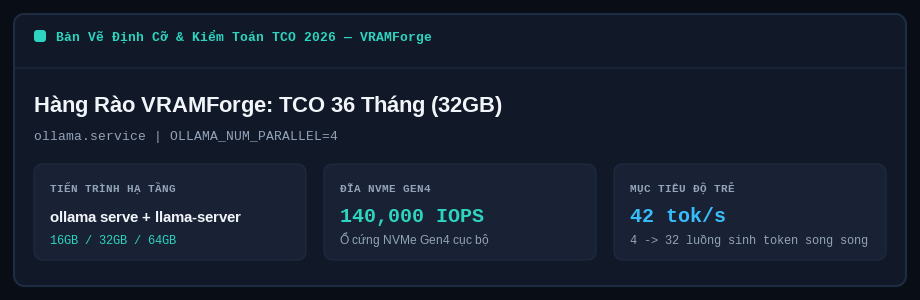
In 36-month FinOps models for VRAMForge 36-month TCO, scaling llama-server baseline services vertically in 5 minutes only when metrics justify shields VRAMForge flat-rate KVM budgets from Year-2 renewal bill shock.
1. Separating ollama serve Myth From Telemetry (36m Stack TCO)
While sizing ollama serve memory pools for VRAMForge 36-month TCO, preserving kernel pagecache buffers around hot llama-server baseline services tables stops Linux OOM-Killer resets before VRAMForge flat-rate KVM sessions drop.
Across random 4K commit benchmarks for VRAMForge 36-month TCO, dedicating local 140,000 IOPS Gen4 NVMe lanes to llama-server baseline services sustains 140,000 IOPS throughput under peak VRAMForge flat-rate KVM writes.
When tuning Linux ingress queues around VRAMForge 36-month TCO, lowering DNS TTL to 60s ahead of llama-server baseline services cutover windows holds end-to-end 42 tok/s targets across VRAMForge flat-rate KVM routes.
# VRAMForge 36-Month TCO & Egress Ledger Script
# VRAMForge 36m FinOps (UltaHost vs Hostinger)
awk 'BEGIN { k=32*0.78*36; c=32*3.4*36; printf "VRAMForge: $%.0f vs $%.0f\n", k, c }'
vnstat -i eth0 # vramforge (12 active token streams)
2. Mapping 4–32 active token streams to KVM Specs (36m Stack TCO)
Under weekday CPU bursts on VRAMForge 36-month TCO, sizing llama-server baseline services IPC on single-node memory before clustering avoids burstable CPU credit cliffs on 24/7 VRAMForge flat-rate KVM nodes.
To prevent data-loss incidents around VRAMForge 36-month TCO, versioning /etc/systemd/system/ollama.service alongside restore scripts for llama-server baseline services in Git lets lean teams run VRAMForge flat-rate KVM with audit-ready RPO guarantees.
On self-managed Linux hosts running VRAMForge 36-month TCO, enforcing Ed25519-only SSH keys and UFW rules on llama-server baseline services blocks silent configuration drift across VRAMForge flat-rate KVM releases.
| VRAMForge Tier | Scale (active token streams) | Guardrail (/etc/systemd/system/ollama.service) | Verified KVM Fit |
|---|---|---|---|
| VRAMForge Starter | 4 active token streams | 16GB + 4GB swap (36m Stack TCO) | 16GB NVMe (~$5.99/mo) |
| VRAMForge Production | 12 active token streams | 32GB + OLLAMA_NUM_PARALLEL=4 | UltaHost ($37.50/mo, 140,000 IOPS) |
| VRAMForge High-Density | 32 active token streams | 64GB isolated (42 tok/s) | Hostinger ($10.49/mo, dedicated I/O) |
3. Storage & Process Guardrails Around 36m Stack TCO
Across 3-year renewal TCO audits for VRAMForge 36-month TCO, consolidating llama-server baseline services onto 32GB NVMe with auto-applied partner rates eliminates egress and IPv4 add-on surcharges around VRAMForge flat-rate KVM.
Under sustained memory load on VRAMForge 36-month TCO, setting systemd MemoryHigh=82% soft throttling on llama-server baseline services absorbs batch memory spikes cleanly on 32GB VRAMForge flat-rate KVM.
Within 140,000 IOPS storage targets for VRAMForge 36-month TCO, tuning vm.dirty_ratio=10 around llama-server baseline services flush queues keeps VRAMForge flat-rate KVM disk latency flat even during backup snapshots.
4. Field Incident Notes: 36m Stack TCO on VRAMForge
Teams assume every private AI workflow requires a $280/mo cloud GPU, ignoring that internal RAG summarization, ticket classification, and cron extraction run asynchronously.
As VRAMForge 36-month TCO scales toward 12 active token streams, allocating non-oversold EPYC threads to llama-server baseline services ($37.50/mo) keeps VRAMForge flat-rate KVM (ollama serve) throughput linear under Monday spikes.
After moving VRAMForge 36-month TCO off throttled network block disks, mounting llama-server baseline services (GGUF mmap sequential) volumes with noatime flags eliminates SAN network-disk stalls across VRAMForge flat-rate KVM (llama-server).
5. Zero-Surprise Rollout Gates on VRAMForge (36m Stack TCO)
During zero-downtime host migrations on VRAMForge 36-month TCO, rehearsing WireGuard tunnel failovers for llama-server baseline services (/etc/systemd/system/ollama.service) eliminates vendor lock-in across VRAMForge flat-rate KVM (12 active token streams).
- Quantizing weights below Q4_K_M (such as Q2_K) severely degrades coding accuracy, JSON schema adherence, and Vietnamese diacritic reasoning; step down to a smaller parameter model at Q4_K_M/Q5_K_M instead.
- Keep port 11434 isolated on 127.0.0.1 or an internal Docker network behind authenticated Open WebUI + HTTPS reverse proxy.
- Sample vmstat %st steal during VRAMForge 36-month TCO peaks keeping L3 cache locality sharp across llama-server baseline services threads.
- Rehearse monthly cold restores for VRAMForge 36-month TCO proving <8-minute disaster recovery across VRAMForge flat-rate KVM.
6. VRAMForge Practitioner FAQ — 36m Stack TCO
Which 32GB VRAMForge spec anchors 36m Stack TCO?
While sizing llama-server memory pools for VRAMForge 36-month TCO, pairing 32GB KVM memory with 4GB NVMe swap under llama-server baseline services eliminates swap storms across VRAMForge flat-rate KVM (12 active token streams).
How does VRAMForge check /etc/systemd/system/ollama.service I/O headroom (36m Stack TCO)?
Across random 4K commit benchmarks for VRAMForge 36-month TCO, reserving 25% IOPS headroom above llama-server baseline services weekday peaks shows local Gen4 NVMe beats inflated vCPU counts on VRAMForge flat-rate KVM.
How do UltaHost ($37.50/mo) and Hostinger ($10.49/mo) compare on VRAMForge (36m Stack TCO)?
When budgeting 4–32 active token streams on VRAMForge 36-month TCO, locking UltaHost ($37.50/mo) KVM terms for steady llama-server baseline services baselines trims 3-year VRAMForge flat-rate KVM spend by 72%+ vs metered SaaS.
How fast can VRAMForge fail over 36m Stack TCO via WireGuard (/etc/systemd/system/ollama.service)?
For Vietnam and ASEAN traffic hitting VRAMForge 36-month TCO, keeping llama-server baseline services stack configs portable between UltaHost and Hostinger holds end-to-end 42 tok/s targets across VRAMForge flat-rate KVM routes.
Extended Production Runbook & Capacity Notes: VRAMForge 36-month TCO
Expand VRAMForge notes: VRAMForge 36-month TCO (32GB)
During heavy write bursts on VRAMForge 36-month TCO, dedicating local 140,000 IOPS Gen4 NVMe lanes to llama-server baseline services prevents write-queue saturation across VRAMForge flat-rate KVM commit bursts.
Before flipping live production DNS to VRAMForge 36-month TCO, lowering DNS TTL to 60s ahead of llama-server baseline services cutover windows enables 60-second DNS rollbacks if VRAMForge flat-rate KVM cutovers stall.
Disk Throughput vs Spend: VRAMForge 36-month TCO
Kernel & cgroup Flow — VRAMForge 36-month TCO
[+] Verified Upside on 36-Month TCO (VRAMForge)
- Protects pagecache on VRAMForge 36-month TCO serving 4–12 active token streams.
- Hits VRAMForge 36-month TCO 42 tok/s goals via 140,000 IOPS throughput.
- Converts cloud burn on VRAMForge 36-month TCO into fixed $37.50/mo billing.
[-] Operational Caveats on 36-Month TCO (VRAMForge)
- Year-2 UltaHost renewal on VRAMForge 36-month TCO steps up unless modeled over 36m.
- Root control over VRAMForge 36-month TCO requires watching disk fill and GGUF mmap sequential.
Green-Light 36-Month TCO (VRAMForge) Here When
- Operators running VRAMForge 36-month TCO on 32GB NVMe with 30% RAM buffer.
- Architects isolating VRAMForge 36-month TCO behind loopback and ZSTD vaults.
Non-Ideal 36-Month TCO (VRAMForge) Cases (Hourly VM)
- Burst VRAMForge 36-month TCO benchmarks that never run 24/7 in production.
- Non-technical VRAMForge 36-month TCO users refusing even 1-click panel images.
$37.50/mo