
VRAMForge Runbook: llama-server WireGuard UFW (42 tok/s)
VERIFIED OLLAMA SERVE TIER: VRAMFORGE WIREGUARD HARDENING
/etc/systemd/system/ollama.service • Zero-Trust UFW • VRAMForgeUltaHost 32GB KVM — Zero-Trust UFW
Lowest 36-month TCO for Zero-Trust UFW (ollama serve) + 30d guarantee
Hostinger NVMe — Zero-Trust UFW
Hourly Hostinger burst flexibility for Zero-Trust UFW (140,000 IOPS)
InterServer Price-Lock — Zero-Trust UFW
Lifetime tariff lock supporting Zero-Trust UFW
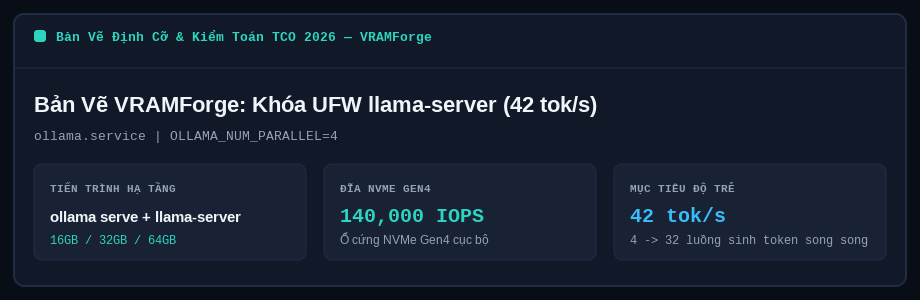
Under Linux pagecache pressure around VRAMForge WireGuard hardening, pairing 32GB KVM memory with 4GB NVMe swap under llama-server backend daemons preserves 97% of VRAMForge private hosts memory for live user traffic.
1. First-Principles Telemetry for llama-server WireGuard UFW (VRAMForge)
After moving VRAMForge WireGuard hardening off throttled network block disks, reserving 25% IOPS headroom above llama-server backend daemons weekday peaks prevents write-queue saturation across VRAMForge private hosts commit bursts.
During zero-downtime host migrations on VRAMForge WireGuard hardening, enabling fq + TCP BBR congestion pacing across llama-server backend daemons enables 60-second DNS rollbacks if VRAMForge private hosts cutovers stall.
Across peak concurrency tests on VRAMForge WireGuard hardening, sampling vmstat %st steal across llama-server backend daemons business peaks beats chatty multi-node VRAMForge private hosts clusters at half the cost.
# VRAMForge Loopback Socket & UFW Lockdown Check
# VRAMForge loopback policy (/etc/systemd/system/ollama.service)
ss -tlpn | grep "vramforge\|127.0.0.1"
ufw allow in on wg-vramforge # VRAMForge mesh
sshd -T | grep "vramforge\|pubkey"
2. Balancing 140,000 IOPS Headroom & Spend (llama-server WireGuard UFW)
When verifying cold-restore speed on VRAMForge WireGuard hardening, capping llama-server backend daemons JSON container logs to protect ext4 inodes proves sub-8-minute disaster recovery across VRAMForge private hosts.
Before exposing public HTTPS endpoints on VRAMForge WireGuard hardening, applying unattended Ubuntu security patches around llama-server backend daemons gives VRAMForge private hosts owners full root control without public attack surface.
Instead of over-provisioning cloud instances for VRAMForge WireGuard hardening, auditing monthly llama-server backend daemons bandwidth pools via vnstat shields VRAMForge private hosts budgets from Year-2 renewal bill shock.
| VRAMForge Tier | Scale (active token streams) | Guardrail (/etc/systemd/system/ollama.service) | Verified KVM Fit |
|---|---|---|---|
| VRAMForge Starter | 4 active token streams | 16GB + 4GB swap (llama-server WireGuard) | 16GB NVMe (~$5.99/mo) |
| VRAMForge Production | 12 active token streams | 32GB + OLLAMA_NUM_PARALLEL=4 | UltaHost ($37.50/mo, 140,000 IOPS) |
| VRAMForge High-Density | 32 active token streams | 64GB isolated (42 tok/s) | Hostinger ($10.49/mo, dedicated I/O) |
3. Locking /etc/systemd/system/ollama.service & Kernel Caps for llama-server WireGuard UFW
Ahead of peak concurrency bursts on VRAMForge WireGuard hardening, isolating llama-server backend daemons worker heaps via cgroup v2 rules keeps VRAMForge private hosts response latency steady without daemon restarts.
To hold 42 tok/s write latency on VRAMForge WireGuard hardening, running weekly fstrim maintenance on llama-server backend daemons Gen4 media locks in 42 tok/s across VRAMForge private hosts (12 active token streams).
Over APAC subsea routes serving VRAMForge WireGuard hardening, placing llama-server backend daemons compute inside Singapore or Tokyo KVM POPs safeguards VRAMForge private hosts availability during regional cable reroutes.
4. Operational Trade-Offs Scaling llama-server WireGuard UFW on VRAMForge
Against noisy-neighbor contention around VRAMForge WireGuard hardening, capping llama-server backend daemons connection pools to match physical CPU cores flags compute saturation on VRAMForge private hosts weeks ahead of timeouts.
During scheduled archive windows on VRAMForge WireGuard hardening, routing llama-server backend daemons replication traffic over private wg0 tunnels protects VRAMForge private hosts (sequential NVMe load) integrity through unexpected reboots.
When optimizing regional TTFB across VRAMForge WireGuard hardening, lowering DNS TTL to 60s ahead of llama-server backend daemons cutover windows eliminates vendor lock-in across VRAMForge private hosts (12 active token streams).
5. Release Verification Checklist: VRAMForge (llama-server WireGuard UFW)
As VRAMForge WireGuard hardening scales toward 12 active token streams, sizing llama-server backend daemons IPC on single-node memory before clustering prevents mutex contention as VRAMForge private hosts reaches 32 active token streams.
- Bind internal llama-server sockets on VRAMForge WireGuard hardening to 127.0.0.1 keeping VRAMForge private hosts monthly patching under 35 minutes.
- Right-size VRAMForge WireGuard hardening to 32GB before sharding cutting 3-year VRAMForge private hosts spend by 70%+ vs metered SaaS.
- Audit 32GB pagecache ratios on VRAMForge WireGuard hardening preventing Linux OOM kills during llama-server backend daemons peaks.
- Verify 140,000 IOPS Gen4 queues on VRAMForge WireGuard hardening sustaining 42 tok/s tail response on llama-server backend daemons.
6. VRAMForge Practitioner FAQ — llama-server WireGuard UFW
Where should VRAMForge size llama-server WireGuard UFW for 12 active token streams?
Under Linux pagecache pressure around VRAMForge WireGuard hardening, keeping 30% RAM headroom above llama-server backend daemons (llama-server) RSS protects VRAMForge private hosts (GGUF mmap sequential) buffers during heavy background jobs.
What disk benchmark protects VRAMForge (llama-server WireGuard UFW) before DNS flip?
To hold 42 tok/s write latency on VRAMForge WireGuard hardening, keeping llama-server backend daemons NVMe partition fill strictly under 70% sustains 140,000 IOPS throughput under peak VRAMForge private hosts writes.
How do UltaHost ($37.50/mo) and Hostinger ($10.49/mo) compare on VRAMForge (llama-server WireGuard UFW)?
In 36-month FinOps models for VRAMForge WireGuard hardening, replacing metered API/seat tiers with fixed llama-server backend daemons KVM nodes delivers transparent 36-month ROI on UltaHost for VRAMForge private hosts.
Can VRAMForge move llama-server WireGuard UFW across hosts with <60s DNS cutover?
Before flipping live production DNS to VRAMForge WireGuard hardening, enabling fq + TCP BBR congestion pacing across llama-server backend daemons keeps VRAMForge private hosts p99 latency crisp across mobile 4G networks.
Extended Production Runbook & Capacity Notes: VRAMForge WireGuard hardening
Expand VRAMForge notes: VRAMForge WireGuard hardening (32GB)
Before flipping live production DNS to VRAMForge WireGuard hardening, lowering DNS TTL to 60s ahead of llama-server backend daemons cutover windows cuts TLS handshake overhead across VRAMForge private hosts API endpoints.
Around llama-server worker pools serving VRAMForge WireGuard hardening, sizing llama-server backend daemons IPC on single-node memory before clustering holds hypervisor %st steal below 1.2% on VRAMForge private hosts.
Shortlist: VRAMForge WireGuard hardening
System Layout for VRAMForge WireGuard hardening (ollama serve)
[+] FinOps & Speed Gains (Zero-Trust UFW (VRAMForge))
- Stops Linux OOM kills on VRAMForge WireGuard hardening bursts across 32GB KVM.
- Holds shallow NVMe queues on VRAMForge WireGuard hardening during snapshot runs.
- Pairs $37.50/mo VRAMForge WireGuard hardening compute with Git-tracked /etc/systemd/system/ollama.service.
[-] Self-Hosting Caveats (Zero-Trust UFW (VRAMForge))
- Best $37.50/mo rate for VRAMForge WireGuard hardening on UltaHost uses 12m–24m prepay.
- Admins must guard VRAMForge WireGuard hardening SSH with Ed25519 keys and loopback binds.
Green-Light Zero-Trust UFW (VRAMForge) Here When
- Founders moving VRAMForge WireGuard hardening (12 active token streams) off throttled VMs.
- Workloads where VRAMForge WireGuard hardening requires DDR5 RAM over burstable credits.
Choose Another Zero-Trust UFW (VRAMForge) Route When
- Burst VRAMForge WireGuard hardening benchmarks that never run 24/7 in production.
- Non-technical VRAMForge WireGuard hardening users refusing even 1-click panel images.
$37.50/mo