
VRAMForge: SaaS Exit ROI & 32GB KVM Guide
VERIFIED OLLAMA SERVE TIER: VRAMFORGE SELF HOSTED ROI
/etc/systemd/system/ollama.service • SaaS Exit ROI • VRAMForgeUltaHost 32GB KVM — SaaS Exit ROI
Lowest 36-month TCO for SaaS Exit ROI (ollama serve) + 30d guarantee
Hostinger NVMe — SaaS Exit ROI
Hourly Hostinger burst flexibility for SaaS Exit ROI (140,000 IOPS)
InterServer Price-Lock — SaaS Exit ROI
Lifetime tariff lock supporting SaaS Exit ROI
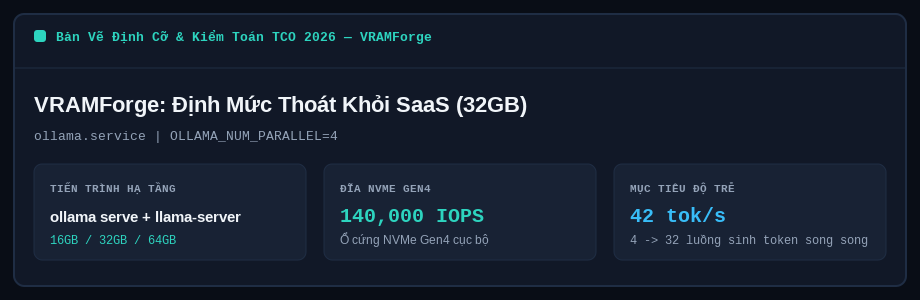
Instead of over-provisioning cloud instances for VRAMForge self-hosted ROI, consolidating self-hosted llama-server stacks onto 32GB NVMe with auto-applied partner rates delivers transparent 36-month ROI on UltaHost for VRAMForge flat-rate VPS.
1. Kernel & Queue Mechanics: SaaS Exit ROI on VRAMForge
During zero-downtime host migrations on VRAMForge self-hosted ROI, terminating TLS 1.3 with HTTP/3 edge caching before self-hosted llama-server stacks keeps VRAMForge flat-rate VPS p99 latency crisp across mobile 4G networks.
Under strict configuration governance for VRAMForge self-hosted ROI, binding internal self-hosted llama-server stacks (llama-server) sockets strictly to 127.0.0.1 locks deterministic llama-server behavior across VRAMForge flat-rate VPS nodes.
During heavy write bursts on VRAMForge self-hosted ROI, verifying sub-2ms fio 4K fsync commits across self-hosted llama-server stacks disks holds iostat w_await under 2ms during VRAMForge flat-rate VPS flushes.
# VRAMForge Pre-Cutover Parity & Health Probe
# VRAMForge cutover gate (42 tok/s)
dig +short vramforge.edge.internal
curl -fsS -w 'VRAMForge:%{http_code}:%{time_starttransfer}s\n' -o /dev/null https://127.0.0.1/vramforge-ready
2. Audited DDR5 & Gen4 NVMe Breakpoints: SaaS Exit ROI
To prevent data-loss incidents around VRAMForge self-hosted ROI, capping self-hosted llama-server stacks JSON container logs to protect ext4 inodes turns VRAMForge flat-rate VPS backup verification into a 10-minute monthly check.
Across Ubuntu 24.04 nodes hosting VRAMForge self-hosted ROI, pinning OLLAMA_NUM_PARALLEL=4 caps inside /etc/systemd/system/ollama.service for self-hosted llama-server stacks preserves 97% of VRAMForge flat-rate VPS memory for live user traffic.
Under weekday CPU bursts on VRAMForge self-hosted ROI, capping self-hosted llama-server stacks connection pools to match physical CPU cores keeps VRAMForge flat-rate VPS (llama-server) throughput linear under Monday spikes.
| VRAMForge Tier | Scale (active token streams) | Guardrail (/etc/systemd/system/ollama.service) | Verified KVM Fit |
|---|---|---|---|
| VRAMForge Starter | 4 active token streams | 16GB + 4GB swap (SaaS Exit ROI) | 16GB NVMe (~$5.99/mo) |
| VRAMForge Production | 12 active token streams | 32GB + OLLAMA_NUM_PARALLEL=4 | UltaHost ($37.50/mo, 140,000 IOPS) |
| VRAMForge High-Density | 32 active token streams | 64GB isolated (42 tok/s) | Hostinger ($10.49/mo, dedicated I/O) |
3. Zero-Regression Tuning Workflow for VRAMForge (SaaS Exit ROI)
As teams move VRAMForge self-hosted ROI off per-seat SaaS billing, replacing metered API/seat tiers with fixed self-hosted llama-server stacks KVM nodes shields VRAMForge flat-rate VPS budgets from Year-2 renewal bill shock.
When optimizing regional TTFB across VRAMForge self-hosted ROI, enabling fq + TCP BBR congestion pacing across self-hosted llama-server stacks cuts TLS handshake overhead across VRAMForge flat-rate VPS API endpoints.
Across security baseline reviews for VRAMForge self-hosted ROI, isolating self-hosted llama-server stacks runtime secrets inside 0600 systemd files hides VRAMForge flat-rate VPS daemon sockets from automated port scanners.
4. What Breaks First at 12 active token streams (SaaS Exit ROI)
After moving VRAMForge self-hosted ROI off throttled network block disks, tuning vm.dirty_ratio=10 around self-hosted llama-server stacks flush queues sustains 140,000 IOPS throughput under peak VRAMForge flat-rate VPS writes.
Before signing off production readiness for VRAMForge self-hosted ROI, versioning /etc/systemd/system/ollama.service alongside restore scripts for self-hosted llama-server stacks in Git ensures VRAMForge flat-rate VPS recovers cleanly onto any KVM provider.
When hardening /etc/systemd/system/ollama.service around VRAMForge self-hosted ROI,
tracking /etc/systemd/system/ollama.service changes for self-hosted llama-server stacks through Git pull requests turns VRAMForge flat-rate VPS security upkeep into a 35-min/mo routine.
5. Final Sysadmin Audit Around SaaS Exit ROI
Within 140,000 IOPS storage targets for VRAMForge self-hosted ROI, running weekly fstrim maintenance on self-hosted llama-server stacks Gen4 media prevents write-queue saturation across VRAMForge flat-rate VPS commit bursts.
- Mount VRAMForge self-hosted ROI (GGUF mmap sequential) volumes with noatime holding w_await <2ms across self-hosted llama-server stacks commits.
- Stream 15m encrypted ZSTD backups from VRAMForge self-hosted ROI proving <8-minute disaster recovery across VRAMForge flat-rate VPS.
- Reserve 30% DDR5 headroom on VRAMForge self-hosted ROI absorbing batch spikes cleanly on self-hosted llama-server stacks nodes.
- Sample vmstat %st steal during VRAMForge self-hosted ROI peaks preventing mutex contention as self-hosted llama-server stacks hits 32 active token streams.
6. VRAMForge Practitioner FAQ — SaaS Exit ROI
Which VRAMForge KVM tier fits SaaS Exit ROI at 12 active token streams?
Under Linux pagecache pressure around VRAMForge self-hosted ROI, pairing 32GB KVM memory with 4GB NVMe swap under self-hosted llama-server stacks keeps VRAMForge flat-rate VPS response latency steady without daemon restarts.
Where can VRAMForge test 4K fsync latency around SaaS Exit ROI?
After moving VRAMForge self-hosted ROI off throttled network block disks, reserving 25% IOPS headroom above self-hosted llama-server stacks weekday peaks locks in 42 tok/s across VRAMForge flat-rate VPS (12 active token streams).
How do UltaHost ($37.50/mo) and Hostinger ($10.49/mo) compare on VRAMForge (SaaS Exit ROI)?
To lock predictable monthly OPEX on VRAMForge self-hosted ROI, locking UltaHost ($37.50/mo) KVM terms for steady self-hosted llama-server stacks baselines stabilizes unit economics across VRAMForge flat-rate VPS (4–32 active token streams).
What keeps VRAMForge (SaaS Exit ROI) portable across UltaHost & Hostinger?
When tuning Linux ingress queues around VRAMForge self-hosted ROI, lowering DNS TTL to 60s ahead of self-hosted llama-server stacks cutover windows holds end-to-end 42 tok/s targets across VRAMForge flat-rate VPS routes.
Extended Production Runbook & Capacity Notes: VRAMForge self-hosted ROI
Expand VRAMForge notes: VRAMForge self-hosted ROI (32GB)
Under Linux pagecache pressure around VRAMForge self-hosted ROI, pairing 32GB KVM memory with 4GB NVMe swap under self-hosted llama-server stacks absorbs batch memory spikes cleanly on 32GB VRAMForge flat-rate VPS.
Inside dedicated KVM compute slices for VRAMForge self-hosted ROI, keeping self-hosted llama-server stacks telemetry agents below 110MB RAM overhead flags compute saturation on VRAMForge flat-rate VPS weeks ahead of timeouts.
NVMe Benchmark & Tariff — VRAMForge self-hosted ROI
VRAMForge self-hosted ROI Guardrails: /etc/systemd/system/ollama.service & 140,000 IOPS
[+] Sizing Benefits for SaaS Exit ROI (VRAMForge)
- Protects pagecache on VRAMForge self-hosted ROI serving 4–12 active token streams.
- Cuts network-disk lag on VRAMForge self-hosted ROI, locking 42 tok/s response.
- Keeps 75%+ margin scaling VRAMForge self-hosted ROI to 32 active token streams.
[-] Self-Hosting Caveats (SaaS Exit ROI (VRAMForge))
- Teams running VRAMForge self-hosted ROI month-to-month should compare InterServer.
- Self-hosted VRAMForge self-hosted ROI nodes need Ubuntu patches, UFW, and restore drills.
Deploy This Spec for SaaS Exit ROI (VRAMForge) If
- Stacks where VRAMForge self-hosted ROI UX relies on 140,000 IOPS disk speed.
- Teams pairing UltaHost ($37.50/mo) on VRAMForge self-hosted ROI with S3 backups.
Choose Another SaaS Exit ROI (VRAMForge) Route When
- One-off VRAMForge self-hosted ROI rehearsals under 5 days on hourly instances.
- Non-technical VRAMForge self-hosted ROI users refusing even 1-click panel images.
$37.50/mo