
VRAMForge Capacity Ledger: llama-server ZSTD 15m RPO
VRAMFORGE SIZING VERDICT: VRAMFORGE 15 MIN RPO BACKUPS
/etc/systemd/system/ollama.service • 15m DR Backup • VRAMForgeUltaHost 32GB KVM — 15m DR Backup
Dedicated 32GB KVM for 15m DR Backup ($37.50/mo)
Hostinger NVMe — 15m DR Backup
Sub-40ms APAC routing on Hostinger for 15m DR Backup ($10.49/mo)
InterServer Price-Lock — 15m DR Backup
Steady flat-rate floor around 15m DR Backup
Across Singapore and Tokyo POP tests for VRAMForge 15-min RPO backups, auditing 100-packet MTR hop loss toward ollama stateful services gateways eliminates vendor lock-in across VRAMForge standby hosts (12 active token streams).
1. Linux Subsystem Constraints on VRAMForge: llama-server ZSTD 15m RPO
Ahead of peak concurrency bursts on VRAMForge 15-min RPO backups, stepping ollama stateful services cleanly up to 64GB when RSS exceeds 80% eliminates swap storms across VRAMForge standby hosts (12 active token streams).
Under strict configuration governance for VRAMForge 15-min RPO backups, enforcing Ed25519-only SSH keys and UFW rules on ollama stateful services streamlines VRAMForge standby hosts incident triage with clean audit logs.
Under weekday CPU bursts on VRAMForge 15-min RPO backups, capping ollama stateful services connection pools to match physical CPU cores holds hypervisor %st steal below 1.2% on VRAMForge standby hosts.
# VRAMForge Atomic Snapshot & Encrypted Restic Sync
# VRAMForge ZSTD vault (GGUF mmap sequential)
restic -r s3:https://vault/vramforge backup /etc/systemd/system/ollama.service --tag "vramforge-16m"
restic -r s3:https://vault/vramforge forget --keep-daily 13
2. VRAMForge Hardware Tiers (16–64GB) for llama-server ZSTD 15m RPO
Whenever VRAMForge 15-min RPO backups pairs llama-server with GGUF mmap sequential, mounting ollama stateful services (GGUF mmap sequential) volumes with noatime flags holds iostat w_await under 2ms during VRAMForge standby hosts flushes.
Instead of over-provisioning cloud instances for VRAMForge 15-min RPO backups, consolidating ollama stateful services onto 32GB NVMe with auto-applied partner rates eliminates egress and IPv4 add-on surcharges around VRAMForge standby hosts.
Before signing off production readiness for VRAMForge 15-min RPO backups, routing ollama stateful services replication traffic over private wg0 tunnels proves sub-8-minute disaster recovery across VRAMForge standby hosts.
| VRAMForge Tier | Scale (active token streams) | Guardrail (/etc/systemd/system/ollama.service) | Verified KVM Fit |
|---|---|---|---|
| VRAMForge Starter | 4 active token streams | 16GB + 4GB swap (llama-server ZSTD 15m) | 16GB NVMe (~$5.99/mo) |
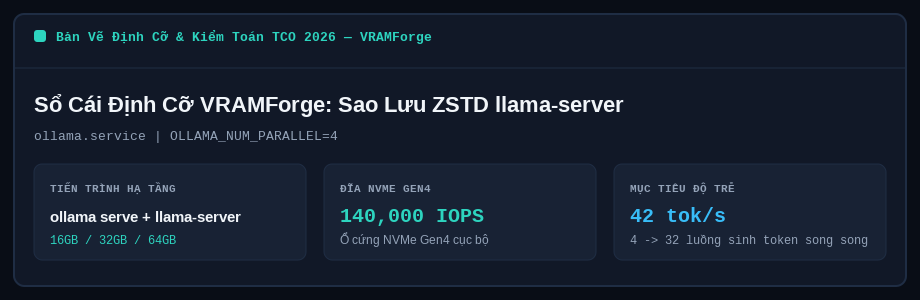
| VRAMForge Production | 12 active token streams | 32GB + OLLAMA_NUM_PARALLEL=4 | UltaHost ($37.50/mo, 140,000 IOPS) |
| VRAMForge High-Density | 32 active token streams | 64GB isolated (42 tok/s) | Hostinger ($10.49/mo, dedicated I/O) |
3. Preventing llama-server Drift Inside /etc/systemd/system/ollama.service (VRAMForge)
When tuning Linux ingress queues around VRAMForge 15-min RPO backups, enabling fq + TCP BBR congestion pacing across ollama stateful services safeguards VRAMForge standby hosts availability during regional cable reroutes.
Under sustained memory load on VRAMForge 15-min RPO backups, setting systemd MemoryHigh=82% soft throttling on ollama stateful services stabilizes VRAMForge standby hosts uptime from $37.50/mo on UltaHost KVM.
Before exposing public HTTPS endpoints on VRAMForge 15-min RPO backups, tracking /etc/systemd/system/ollama.service changes for ollama stateful services through Git pull requests turns VRAMForge standby hosts security upkeep into a 35-min/mo routine.
4. Senior Sysadmin Notes: Stopping llama-server ZSTD 15m RPO Regressions
On CPU-only VDS deployments, verifying avx2 or avx512 instruction flags in lscpu plus multi-channel DDR5 physical RAM is mandatory to achieve usable 8 to 18 tokens per second on 8B–14B Q4_K_M.
Across random 4K commit benchmarks for VRAMForge 15-min RPO backups, tuning vm.dirty_ratio=10 around ollama stateful services flush queues keeps VRAMForge standby hosts disk latency flat even during backup snapshots.
Across security baseline reviews for VRAMForge 15-min RPO backups, binding internal ollama stateful services (llama-server) sockets strictly to 127.0.0.1 hides VRAMForge standby hosts daemon sockets from automated port scanners.
5. Cutover & 60s Rollback Gates (VRAMForge)
Inside dedicated KVM compute slices for VRAMForge 15-min RPO backups, sampling vmstat %st steal across ollama stateful services business peaks keeps CPU L3 cache locality sharp across VRAMForge standby hosts workers.
- Reserve 30% DDR5 headroom on VRAMForge 15-min RPO backups eliminating swap thrash across 32GB VRAMForge standby hosts VMs.
- Enforce Ed25519 SSH keys across VRAMForge 15-min RPO backups blocking credential brute-force noise on ollama stateful services.
- Match llama-server worker counts on VRAMForge 15-min RPO backups to nproc keeping L3 cache locality sharp across ollama stateful services threads.
- Keep sequential NVMe load disk fill under 70% for VRAMForge 15-min RPO backups shielding VRAMForge standby hosts (sequential NVMe load) from write amplification.
6. VRAMForge Practitioner FAQ — llama-server ZSTD 15m RPO
How do VRAMForge teams pick KVM RAM around llama-server ZSTD 15m RPO?
Across Ubuntu 24.04 nodes hosting VRAMForge 15-min RPO backups, stepping ollama stateful services cleanly up to 64GB when RSS exceeds 80% preserves 97% of VRAMForge standby hosts memory for live user traffic.
How do VRAMForge ops verify 140,000 IOPS queues on llama-server ZSTD 15m RPO?
During heavy write bursts on VRAMForge 15-min RPO backups, mounting ollama stateful services (sequential NVMe load) volumes with noatime flags prevents write-queue saturation across VRAMForge standby hosts commit bursts.
How do UltaHost ($37.50/mo) and Hostinger ($10.49/mo) compare on VRAMForge (llama-server ZSTD 15m RPO)?
As teams move VRAMForge 15-min RPO backups off per-seat SaaS billing, consolidating ollama stateful services onto 32GB NVMe with auto-applied partner rates shields VRAMForge standby hosts budgets from Year-2 renewal bill shock.
Does VRAMForge (llama-server ZSTD 15m RPO) support zero-lock-in host migration?
When optimizing regional TTFB across VRAMForge 15-min RPO backups, terminating TLS 1.3 with HTTP/3 edge caching before ollama stateful services cuts TLS handshake overhead across VRAMForge standby hosts API endpoints.
Disk Throughput vs Spend: VRAMForge 15-min RPO backups
Kernel & cgroup Flow — VRAMForge 15-min RPO backups
[+] Sizing Benefits for 15m DR Backup (VRAMForge)
- Sizes ollama serve RSS cleanly for VRAMForge 15-min RPO backups on 32GB NVMe.
- Prevents fsync stalls on VRAMForge 15-min RPO backups in ollama serve (140,000 IOPS).
- Trims 36m VRAMForge 15-min RPO backups spend by 70%–85% vs metered SaaS.
[-] Procurement Notes: 15m DR Backup (VRAMForge)
- 30-day cycles on VRAMForge 15-min RPO backups miss the deepest UltaHost cart rebate.
- Base OS images for VRAMForge 15-min RPO backups need /etc/systemd/system/ollama.service caps plus 4GB swap.
Green-Light 15m DR Backup (VRAMForge) Here When
- FinOps leads auditing 36m VRAMForge 15-min RPO backups spend (16–64GB).
- Squads cutting cloud waste on VRAMForge 15-min RPO backups down to 32GB KVM.
Avoid Annual Prepay on 15m DR Backup (VRAMForge) If
- 2-hour VRAMForge 15-min RPO backups failover drills torn down right after testing.
- Teams on VRAMForge 15-min RPO backups unwilling to touch /etc/systemd/system/ollama.service or Linux CLI.
$37.50/mo